Construction Equipment Tracking: Records, Custody and Service
Construction companies lose money on equipment that goes missing, sits idle or breaks after missed servicing. How to keep a register of every machine and tool, who has it and when it was last serviced.
Construction equipment goes missing in two ways: it is stolen, or it is forgotten on a site that finished months ago. Add the machines that break because nobody serviced them, and the plant you hire in while your own sits idle somewhere else, and equipment ends up as one of the biggest ways a construction business loses money.
"Equipment tracking" can mean two different things, and it helps to keep them apart.
Two kinds of tracking
- GPS tracking of the machine itself: a telematics device on an excavator or generator that reports location and engine hours. It is useful for large plant and for recovering stolen equipment.
- Record-keeping: a register of what you own, where it should be, who is responsible for it and what servicing it has had.
Most companies need the second much more than the first, and it costs far less. GPS can show where a machine is, but only a record says which person is responsible for knowing.
The equipment register
For each item of plant and each valuable tool, record:
- name, type, manufacturer, model and serial number;
- purchase date, warranty provider and expiry;
- the site it is on now;
- the person responsible, usually the site manager or operator who has it;
- status: available, in use, under maintenance or retired;
- documents such as manuals, inspection certificates and insurance.
Custody
The rule that works best is to assign every item to a named person. When it moves to another site or person, update the record. If something goes missing, there is then one person to ask, instead of a group who each assumed someone else had it.
At the end of each project, before the team leaves the site, check the register against what is actually there.
Servicing
Missed services lead to breakdowns. Put each machine on a service schedule, record every service and repair against it, and keep inspection certificates attached. The history also shows you when repairs have started to cost more than a replacement would.
Utilisation
Look at status over time. If something has been "available" for months, consider selling it or moving it to a busy site before you hire in the same thing elsewhere.
Small tools and consumables
Tools and consumables that are not worth their own record can be kept as stock counts by location (the yard, each site container), with a record of what is issued to each person or used on each job.
In Movtro
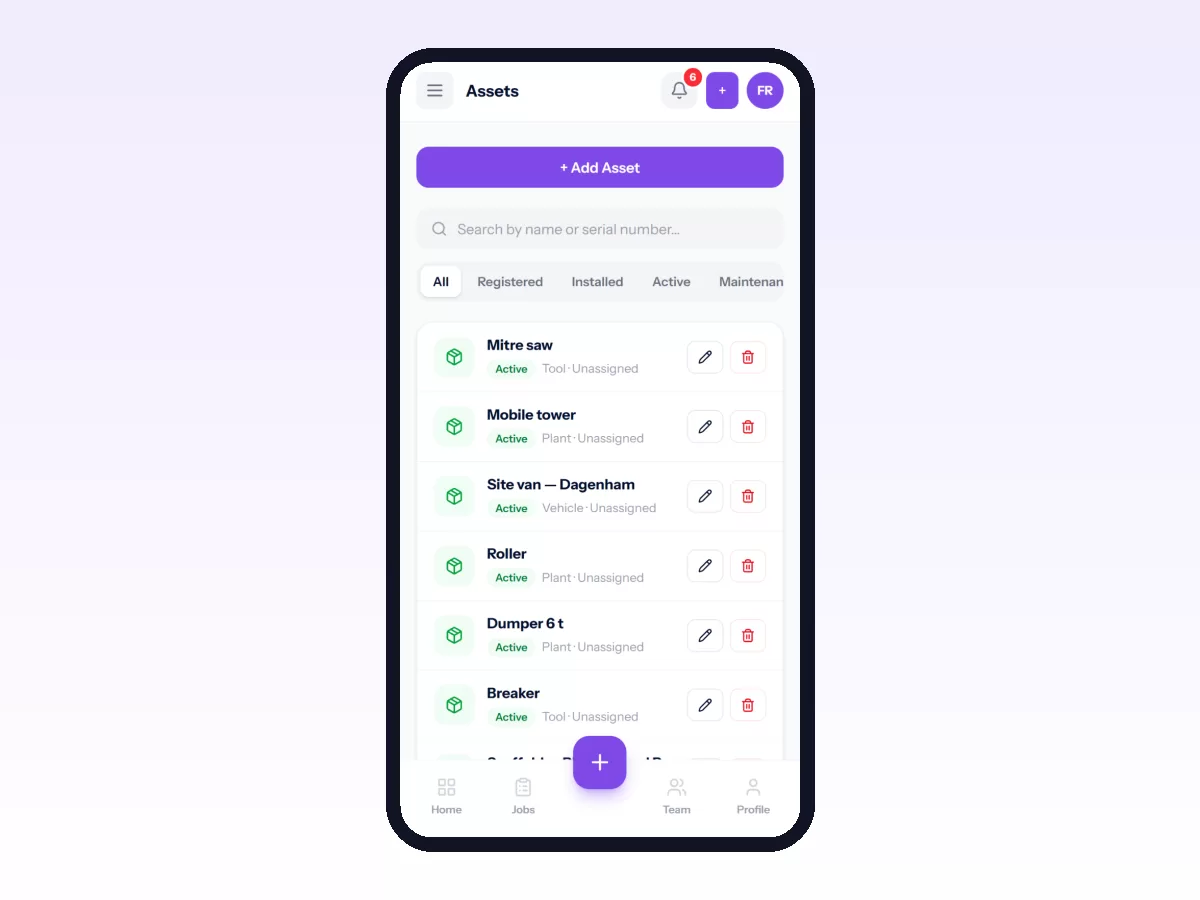
In Movtro each machine or tool is an asset with type, manufacturer, model, serial number, purchase date, warranty, status and documents. An asset belongs to a site and can be assigned to a person. The asset report shows time spent in each status and warranty status across the fleet. Every service or repair job appears in the asset's history, and recurring jobs schedule the servicing. Small tools and consumables can be held as stock by location, then issued and transferred.
Movtro does not connect to GPS trackers or telematics, does not read engine hours and does not handle equipment hire billing.
Related reading: construction workforce management, equipment service history and field service inventory management. Or start free.