Insurance Survey and Claim Inspection Visits
Surveyors and claim inspectors have to get there quickly, capture proper evidence and show the visit happened. This is how to run risk surveys and claim inspections as a field operation.
Insurance companies, loss adjusters and survey firms send people into the field for two main reasons: risk surveys before a policy is written, and claim inspections after something has gone wrong. Both need the right surveyor, a visit that really took place, and evidence that holds up.
Assigning visits
- Match the surveyor to the risk, whether that is motor, property, marine, engineering or agriculture.
- Think about location. Claims need speed, so the nearest qualified surveyor usually gets the visit.
- Spread the workload so one surveyor is not carrying thirty open files while another has five.
- Record when each visit was assigned so you can measure turnaround.
A consistent visit
For a given type of visit, every surveyor should cover the same points. A checklist for each visit type handles this:
Property risk survey: construction and occupancy, fire protection, security, housekeeping, hazards, and photos of each elevation.
Motor claim inspection: vehicle identification, damage by area, photos from standard angles, the odometer reading and the driver's statement.
Property claim inspection: cause of loss, damaged areas and items, photos, measurements and the insured's account.
Evidence that holds up
- Photos taken during the visit and attached to the file.
- Where the surveyor was when the visit started, compared with the address.
- The time of the visit.
- Notes written on site rather than pieced together afterwards.
- A signature from the insured or their representative.
- Estimates, invoices and police reports attached to the same record.
Speed and communication
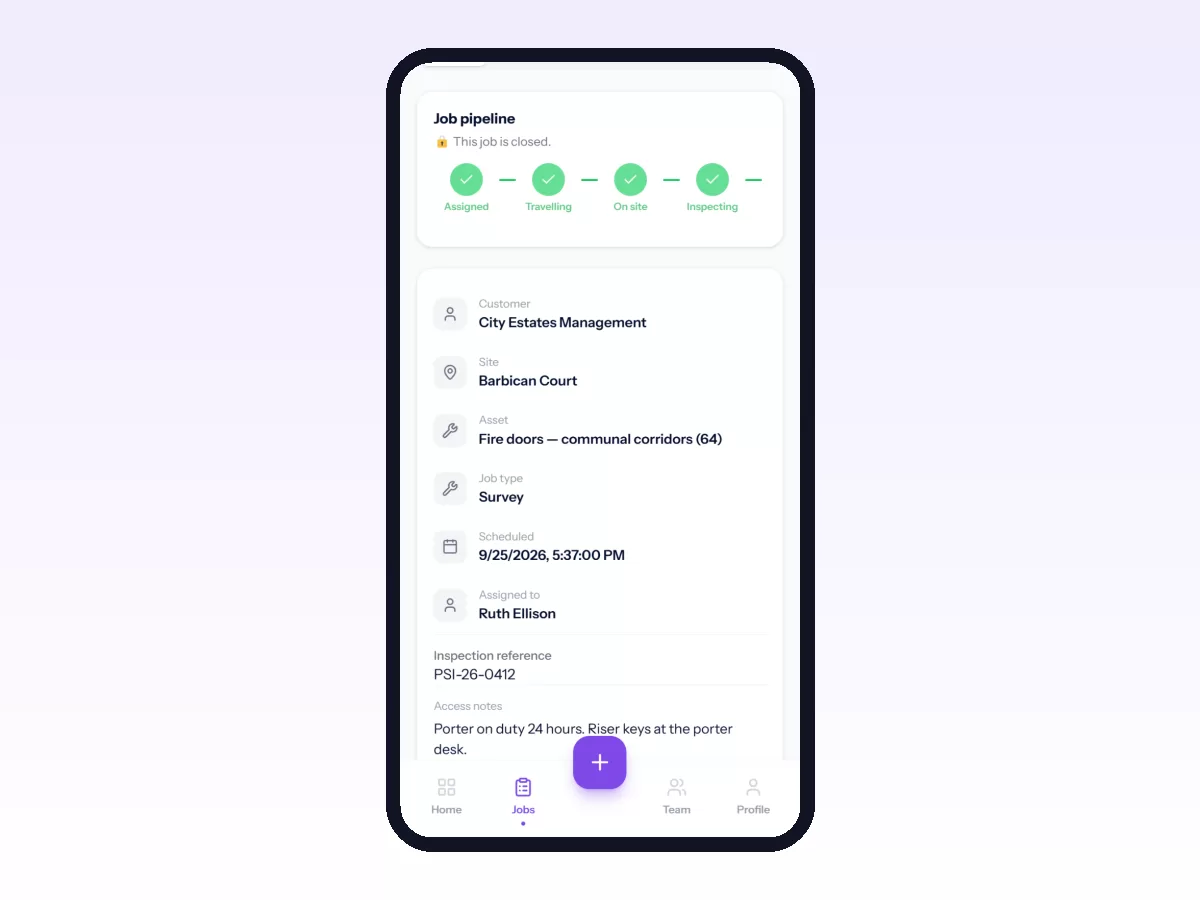
On a claim, the customer judges you by how quickly someone arrives and how well they are kept informed. Track each visit's status (assigned, travelling, on site, completed) so the office can answer calls without ringing the surveyor.
Fraud and quality control
When evidence is captured at the time and place of the visit, staged or remote "inspections" become much harder to pass off. Each month, review a sample of files for completeness and look for surveyors whose visits keep starting away from the address.
Beyond the visit
Surveys and inspections feed underwriting and claims systems. The field record should be complete enough to hand over to them, without trying to replace them.
In Movtro
In Movtro each survey or inspection is a job at the insured's site. You assign it to a surveyor, with a suggestion based on skills, workload, availability and travel time. On the phone, surveyors work through a checklist for the visit type, take photos, write notes, capture the insured's signature and attach documents, and this works without signal too. Starting the visit records where the surveyor was and how far that was from the address, and distant starts are flagged. The office sees the status of each visit, and reports show turnaround and completion for each surveyor.
Movtro is not a claims or policy system. It does not hold policies, reserves or payments. Its checklists take typed answers, readings and photos, can carry points against a pass mark, and can ask a follow-up question only on a given answer, but they are not a free-form form builder.
Related reading: field inspection management, proof of service and insurance field agent tracking. Or start free.