Delivery Driver Attendance and Location Tracking
Delivery drivers have to start on time, stay on route and be paid correctly. How to track attendance and location for a delivery team, and when fleet telematics is the better fit.
Delivery businesses run drivers who are hardly ever in the office: couriers, van drivers, a distributor's delivery staff. Managers need to know who started on time, where each driver is now and how many hours to pay. Customers want to know when their delivery will turn up.
People or vehicles?
First decide what you are actually tracking.
- Vehicle tracking (telematics): a device in the vehicle reports location, speed, route history and engine data. It suits fleets where fuel, driving behaviour and vehicle security matter most.
- People tracking: the driver's attendance, working hours, location during work and what they did. It suits questions about staff, pay and the work itself.
Many businesses need people tracking first and add telematics later once the fleet is large.
Attendance
- Drivers clock in on their phone at the depot or wherever they start, and the location is recorded.
- Working hours and a grace period decide lateness the same way every time.
- Overtime comes from clock-ins rather than claims.
- Missed clock-ins and clock-outs trigger reminders.
Live location, within working hours
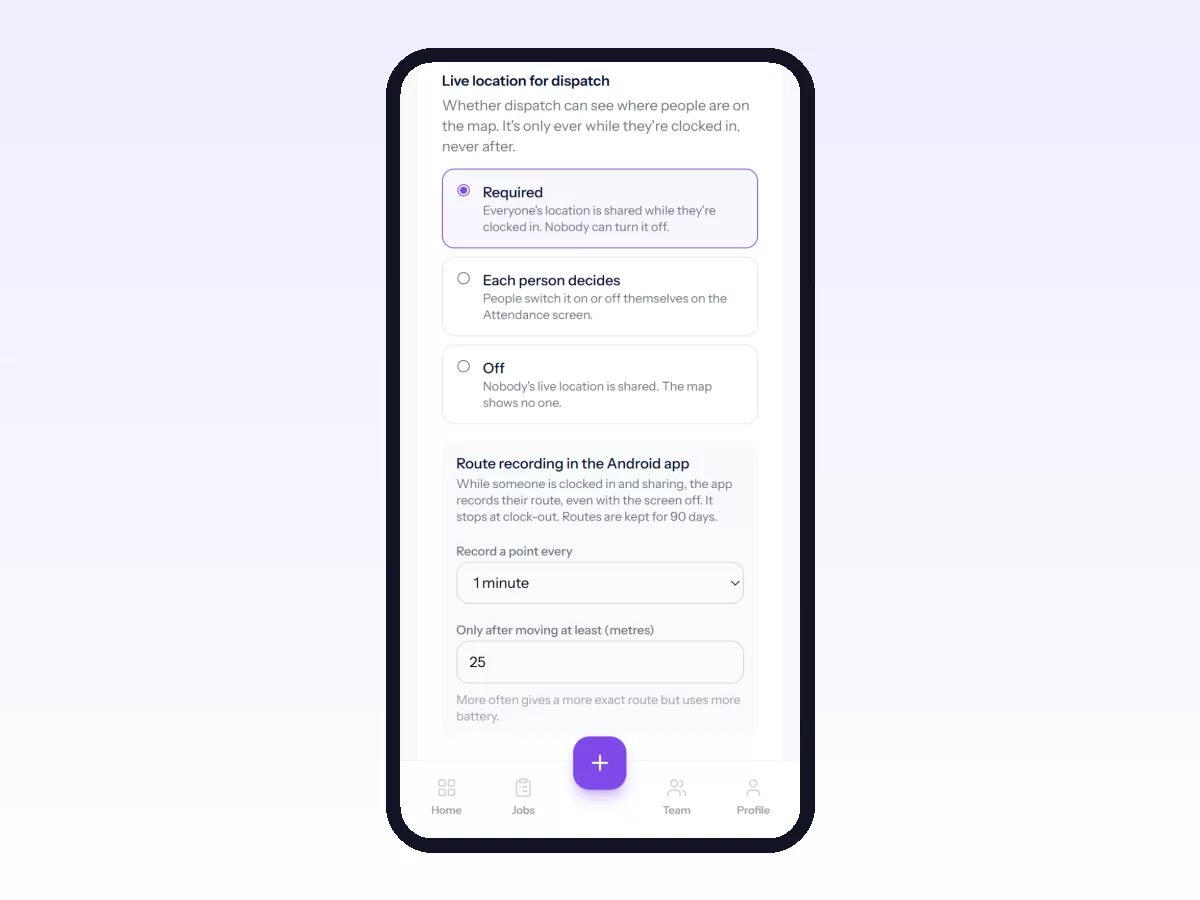
For dispatch and customer questions, you can see where drivers are right now, during working hours only. Decide whether sharing is required or optional and tell drivers which. Location outside working hours is off limits.
The work itself
When a delivery is a job in its own right (a pallet to a site, equipment to a customer, a collection), record it as a job with a photo, the recipient's signature and notes. For high-volume parcel work with dozens of drops, a dedicated delivery app with barcode scanning is usually the better tool.
Customer updates
Customers ring far less to ask "Where is my delivery?" when they can see it is on the way and roughly where the driver is.
Expenses and pay
Drivers submit fuel, parking and tolls from their phone with receipts, and managers approve them in the same system. Payroll is built from attendance and overtime, and drivers receive their payslips.
Fairness
Before you switch anything on, explain what is recorded and why. Use the data to fix problems in the plan, such as routes that are too long or depots that open late, and not only to question drivers.
In Movtro
Movtro covers the people side of a delivery team. That means clock-in and clock-out with location (offline too), grace periods, overtime and reminders; live location shared only while a driver is clocked in, with the day's route recorded by the Android app; jobs with photos, signatures and notes; customers seeing the driver's location while their job is on the way; expenses such as fuel, parking and tolls with receipts and approval; and monthly payroll from attendance.
Movtro is not fleet telematics. It does not connect to vehicle trackers, score driving behaviour, optimise routes or scan parcels. The route it records comes from the driver's phone during their shift, not from the vehicle.
Related reading: how to track field employees, field force tracking software and delivery and installation proof of completion. Or start free.