SLA Management in Field Service
Service level agreements promise response and fix times. How to set them realistically, keep them, and measure whether you do.
A service level agreement is a promise with a clock on it: we will respond within four hours, arrive the same day, fix within forty-eight hours. Customers buy SLAs for certainty, and businesses sell them on premium contracts. They only work if the promises are realistic and the business can see in time when one is about to be broken.
The common SLA measures
- Response time: from the request to an acknowledgement or a plan.
- Arrival time: from the request, or from the scheduled time, until the technician is on site.
- Fix time: from the request until the problem is resolved.
- Uptime: for managed equipment, how much of the time it worked.
Each one needs a clear start and stop. "Four-hour response" means nothing until you agree whether the clock runs overnight and at weekends.
Setting SLAs you can keep
- Base them on your own data rather than your competitors' brochures. If your average arrival for urgent work is five hours, a four-hour promise will turn into penalty payments.
- Tie them to priority. Critical, high and normal work deserve different promises.
- Define business hours and holidays in the agreement.
- Exclude what you cannot control, such as no access, parts on order, or the customer asking to reschedule.
Keeping them
- Dispatch by the promise. The job with the tightest deadline goes first, whoever rang loudest.
- Know which jobs are at risk before they breach.
- Keep common parts on the van, because a return trip breaks fix-time SLAs.
- Keep the customer informed. A customer told early that the technician will be late is far more forgiving than one left waiting.
Measuring honestly
- Compliance rate: the share of jobs within their SLA.
- Breaches: count them and read each one. A single breach on a big contract matters more than the percentage.
- The reasons for breaches, such as capacity, parts, travel or access. Each has a different fix.
- Do not quietly exclude awkward jobs, and do not count a job with no arrival time recorded as compliant just because there is nothing to measure.
See field service KPIs.
In Movtro
Movtro measures on-time performance against one allowance you set for your organisation. A scheduled job is on time if the technician arrives within that many minutes of the scheduled time, or, where no arrival is recorded, completes it within that time. Reports show the compliance rate and the number of breaches by team and by technician. Jobs with nothing to measure are left out rather than counted as on time.
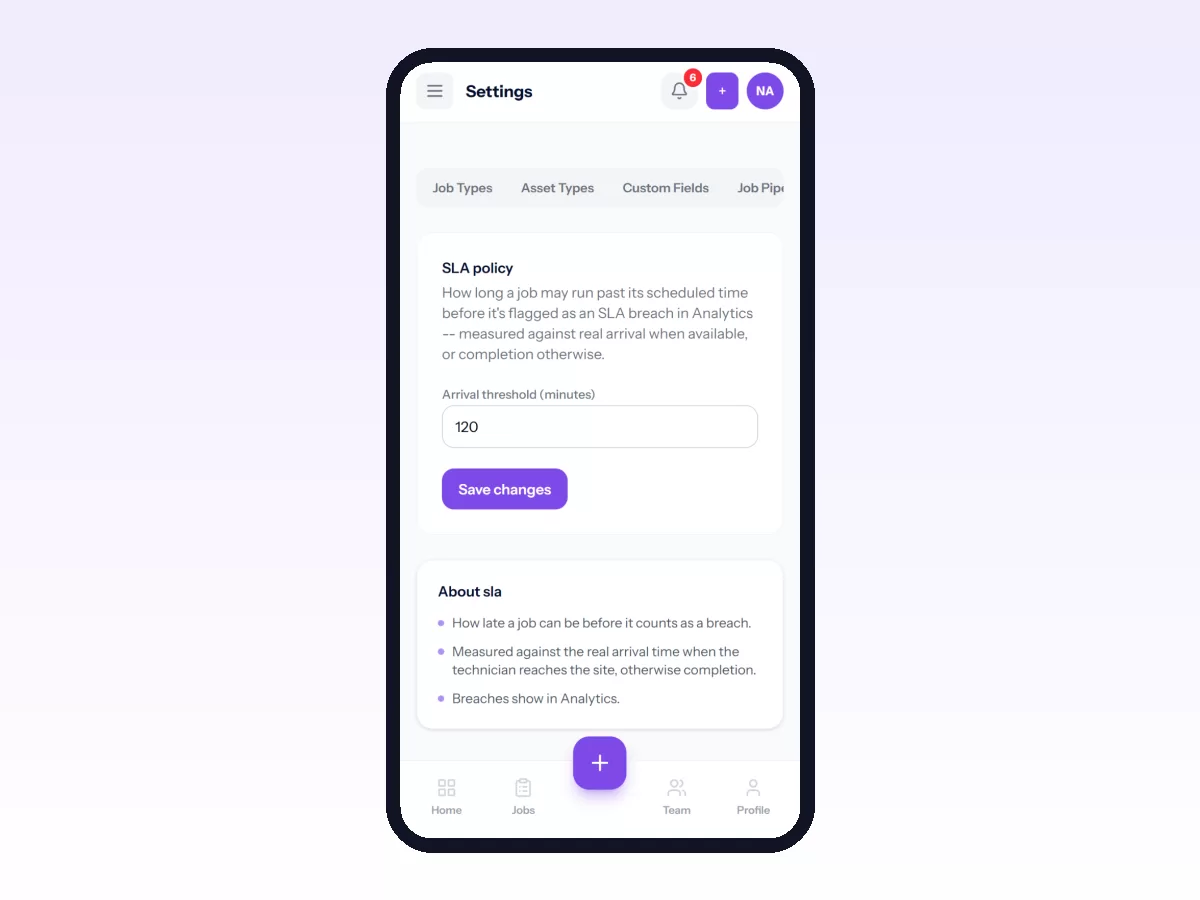
This is narrower than a full SLA system. Movtro does not hold different targets per priority, customer or contract, does not run response clocks from the moment a request arrives, and does not warn you before a job breaches. If you sell tiered SLAs, track the contract terms separately and use Movtro's figures for the arrival side.
See technician dispatch, or start free.
Related: Field Service Automation: Rules That Save Dispatchers Hours · ATM and Vending Machine Service Management