Medical Equipment Service Management
Biomedical service teams look after equipment where downtime affects patients. This covers organising planned maintenance, breakdown calls and equipment records for hospitals and clinics.
Medical equipment service teams, whether in-house biomedical departments or outside service companies, look after equipment where downtime can affect patient care. That means patient monitors, infusion pumps, imaging systems, sterilisers, dental chairs and laboratory analysers. The work centres on planned maintenance, quick response to breakdowns, and records that hold up when someone examines them.
An equipment register you can trust
Each device needs its own record:
- Type, manufacturer, model and serial number.
- Location: hospital, department, room.
- Install date, warranty provider and expiry.
- Status: in use, under maintenance, retired.
- Documents such as service manuals, inspection certificates and calibration reports.
Keep retired equipment on file instead of deleting it, because its history may still be needed.
Planned maintenance
Manufacturers recommend service intervals for each device type, six-monthly for many devices and yearly for others. Set each device's schedule once, let the visits be created in advance, and review overdue maintenance every week. When a department has many identical devices, a single visit covering all of them, with a checklist line for each device, saves time.
Breakdown response
When a device fails, the hospital wants to know when someone will get there. Priority matters, since a failed ventilator and a noisy printer are very different calls. Agree priority levels with each customer, and let the person who raised the request see how the job is progressing.
Consistent records
Every visit should record the same things: which checklist steps were done, what was found, the parts replaced, photos where they help, and sign-off from the department. Consistent records give biomedical managers, and anyone reviewing the service, a history they can use.
Parts
Keep common spares by location and record what is fitted on each job, so each device's history shows the parts replaced.
Qualified engineers
Track engineers' manufacturer training and certifications with their expiry dates, and send only trained engineers to specialised equipment.
Regulation
Each country regulates medical equipment service differently. Check what your regulator and your customers require for records, calibration and traceability, and confirm that any software you use supports it. Software keeps the records, but it does not make a service compliant by itself.
In Movtro
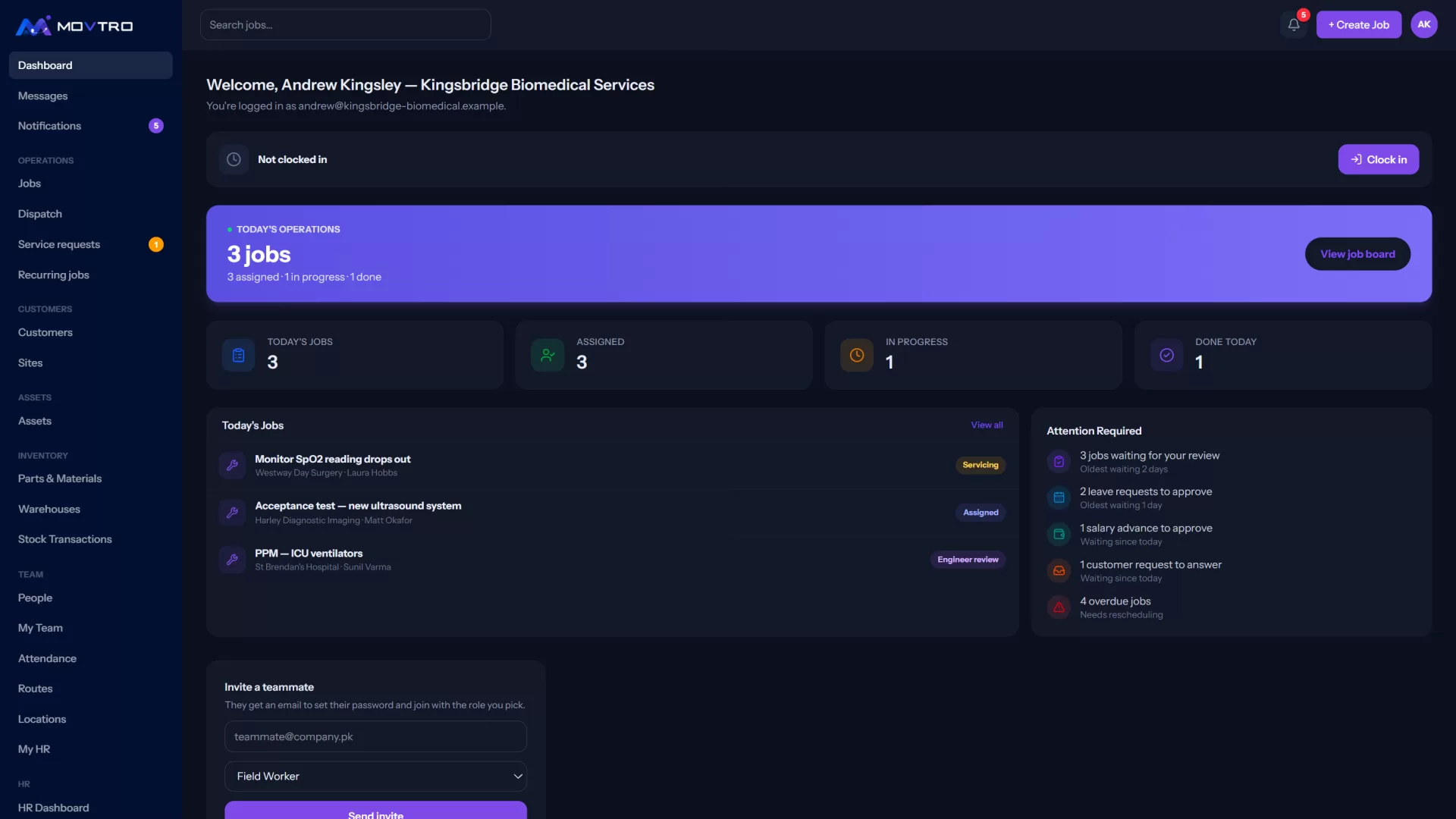

In Movtro each device is an asset with its manufacturer, model, serial number, site, install date, warranty, status and attached documents, and every job shows in its history. Recurring jobs schedule planned maintenance for each device or as one combined visit, and overdue visits are flagged. Jobs carry a priority, and customers can raise requests and follow progress through the portal. Technicians work through checklists, add photos, record parts used from stock and capture a signature. Engineers' skills and certifications are recorded, with reminders before they expire.
Movtro is a general field service system and makes no claim to meet any specific medical device regulation. Readings can be recorded in the checklist with a unit and an allowed range, but Movtro does not manage calibration certificates or traceability for you.
Related reading: equipment service management, equipment service history and preventive maintenance software. Or start free.