Equipment Service Management: Running a Service Business on Other People's Machines
For companies that install and maintain equipment at customer sites: how to organise the installed base, contracts, callouts and parts so every machine gets looked after and every visit is recorded.
An equipment service business looks after machines that belong to someone else: generators at banks, chillers at hotels, lifts in office towers, medical devices in clinics, kitchen equipment in restaurants, industrial plant in factories. What it sells is uptime. What it most needs is information about what is installed where, what has been done to it and what is about to fail.
The installed base
It all starts with knowing what you look after. For each machine, record:
- the customer and the site, and exactly where on the site it is;
- make, model and serial number;
- install date and warranty;
- the contract that covers it, if there is one;
- its service history.
In most businesses this is spread across invoices, spreadsheets and engineers' memories. Gathering it into one list is tedious the first time and pays you back every week after.
The three kinds of work
Planned maintenance under contract is the steady base. It has to happen on schedule and the same way every time. See preventive maintenance software.
Callouts are breakdowns, often urgent and often at the worst moment. Here speed and fixing it first time count most. See first-time fix rate.
Installations and upgrades are project-style work that adds machines to the installed base.
Each type is handled differently, but all of them should end up on the same machine's record.
Contracts
A service contract sets out which machines are covered, how often they are visited, what is included and how fast you respond. In day-to-day terms it turns into a set of planned visits and a priority for callouts. Keep the list of covered machines exact. "All units at the site" leads to arguments as soon as a new unit appears.
Parts
Equipment service depends on parts. Carry common consumables and the parts that fail most in vans, keep specialist parts in the store, and record every part against both the job and the machine. See parts and inventory for field service teams.
Skills
Engineers specialise. A lift engineer isn't a generator engineer, and some equipment can only be worked on with a manufacturer's certification. Assign work by skill and keep certifications up to date.
Reporting to customers
Business customers want proof: a report for each visit, the history of their machines and how quickly you responded when something broke. The companies that keep their contracts are usually the ones whose customers can see all of that without having to ask.
What to measure
- Planned visits completed on time.
- Callout response and first-time fix rate.
- Repeat failures per machine.
- Parts cost per machine per year, which shows when replacing beats repairing.
See field service KPIs.
In Movtro
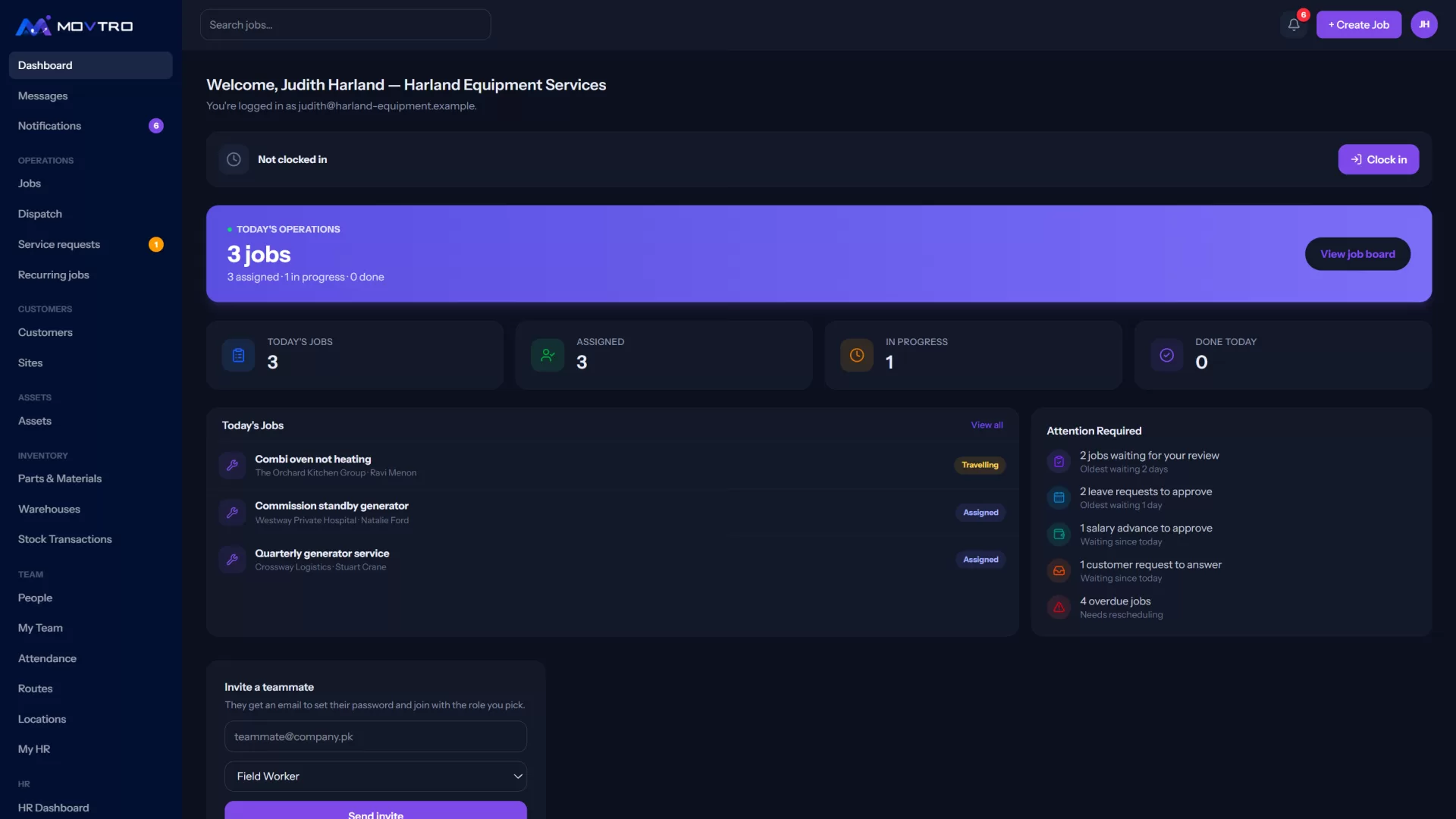
In Movtro each machine is an asset at the customer's site. It has type, make, model, serial number, install and purchase dates, warranty and status, plus a timeline of every visit and status change. Planned maintenance runs as recurring jobs per machine or per site, created ahead of time and flagged when overdue. Callouts are jobs, and customers can also request them through the portal. Dispatch can get a suggested engineer based on skills, workload, availability and travel time. Engineers record checklists, notes, photos, parts from stock and the customer's signature on their phone, with or without signal. Each engineer's skills and certifications are on record, and Movtro sends reminders before certifications expire.
Movtro does not manage contract pricing, invoicing or renewals.
See equipment and asset service history, or start free.
Related: Medical Equipment Service Management · Industrial Equipment Field Service · Commercial Kitchen Equipment Service · Water Treatment and RO Plant Service Management · ATM and Vending Machine Service Management · How to Add Assets and See Their Service History