NGO Field Staff Management: Attendance, Visits, Expenses and Pay
NGO field teams work across districts, often with poor signal, and every visit and rupee has to be accounted for. This covers attendance, visits, expenses and payroll for programme staff.
NGO programmes rely on field staff such as community mobilisers, health workers, trainers and monitoring officers. They work across districts, often in villages with weak signal, and donors expect every visit and every expense to be accounted for. Managing them from head office usually means registers, phone calls and a pile of receipts at the end of the month.
What an NGO needs to know
- Were staff working, and where? You need attendance that stands up in an audit.
- Did the visits happen? Each one needs evidence of where, when and what was done, with photos.
- What was spent on travel, fuel, meals and materials, with receipts and approvals?
- Were people paid correctly, from attendance and approved leave instead of estimates?
- Did everyone get the message? Policy changes and safety notices need to be acknowledged.
Attendance across districts
Staff clock in on their phone wherever they start, and the location is recorded. Many field locations have no signal at all, so clock-in has to work offline and keep the real time. Set working hours and a grace period so lateness is judged the same way for everyone.
Visits with evidence
Set up each community, school, clinic or household group you work with as a site, and each planned visit as a job. During the visit, staff write notes, tick a checklist (activities delivered, materials distributed, follow-ups agreed) and add photos. Starting the visit records where the person was and how far that was from the site.
Repeat visits, such as a monthly session at each school, can go on a schedule so they appear on staff phones automatically.
Expenses and advances
Field programmes run on small expenses. Staff submit them from the phone by category (travel, fuel, meals, communication, materials) with a photo of the receipt. Approval goes to the supervisor and then HR, or to HR only. Advances for field trips are recorded and repaid in instalments, so nothing goes missing between trips.
Payroll and leave
Staff request leave on the phone and it is approved there, with balances for each leave type and holidays taken into account. Monthly payroll is built from attendance and leave, and payslips are sent to staff.
Communication
Send announcements to all staff, one department or selected people, and track acknowledgement for anything that must be read, such as safeguarding updates, travel restrictions and policy changes.
In Movtro
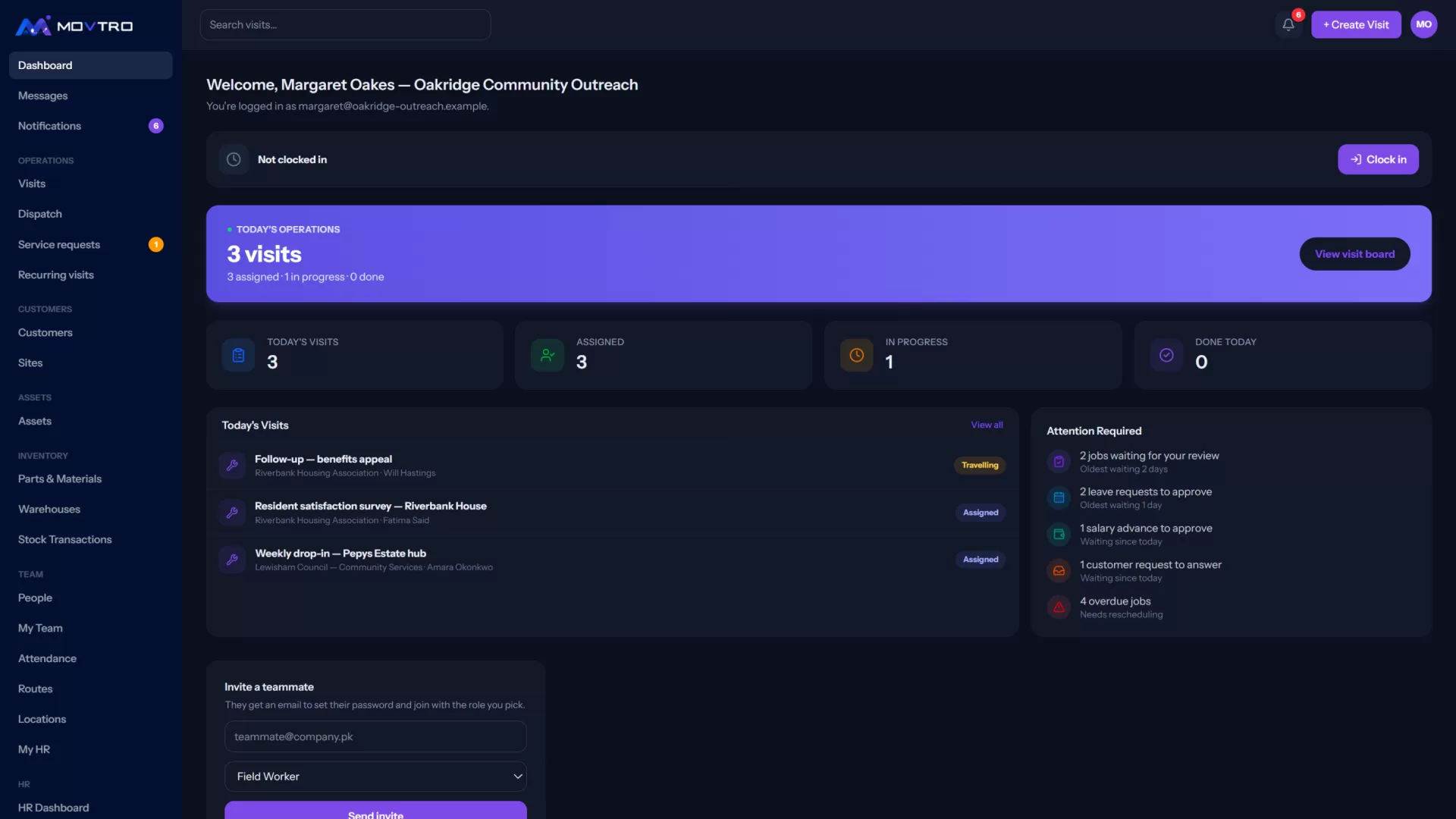
Movtro covers the field side of an NGO. Attendance with location works offline. Visits are jobs at sites, with notes, checklists, photos and the distance from the site, and they can recur. Expenses are filed by category with receipt photos and go through a supervisor-then-HR or HR-only approval flow, and advances are repaid in instalments. There are leave types with balances and holidays, monthly payroll with PDF payslips (tax is entered manually), departments, and announcements with acknowledgement tracking. Reports cover visits, attendance, expenses and payroll.
Movtro does not register beneficiaries or handle donor reporting or grant accounting. Its checklists take typed answers, can ask a follow-up question only on a given answer, can repeat a group of questions for each household or session, and can be scored. That covers simple survey-style forms, but they are not a free-form form builder.
Related reading: field visit tracking, field employee expense management and payroll for field staff. Or start free.