Pest Control Field Service Management
Pest control runs on recurring treatments, chemicals that have to be accounted for, and service reports customers keep. This is how to run it without the paperwork.
Most pest control work repeats. A restaurant is treated monthly, a warehouse quarterly, a home every few months, and a food factory on a schedule its auditors check. On top of that steady base come one-off call-outs for a wasp nest, a termite infestation or a sudden rodent problem.
To run it well you have to never miss a recurring treatment, account for every chemical used, and give each customer a report they can show an inspector.
The work
Recurring treatments
These are the backbone of the business. Each contract has a frequency, a set of areas and a standard method. The risk is simple: a missed treatment loses you a customer, and at a food business it can mean a failed audit.
Call-outs
This is unplanned work, often urgent and often for a new customer. Speed matters, and so does making the first visit lead to a contract.
Inspections and surveys
Many commercial customers want an initial survey, and some want regular inspections of bait stations and traps between treatments.
What each visit records
- The areas treated and anything found, such as activity levels, entry points and damage.
- Products used: what, how much and where. Many customers and inspectors require this.
- Bait stations and traps checked, replaced or moved.
- Recommendations on proofing work, hygiene issues and follow-up.
- Photos, especially of activity and entry points.
- The customer's signature.
A short standard checklist for each kind of treatment keeps technicians consistent without slowing them down.
Chemicals and stock
Pest control products are expensive and often regulated. If you know what each van holds, what was used on each job and what needs reordering, you avoid running out mid-route and product going missing unnoticed. Recording usage on each job also answers the question customers and inspectors ask: what was applied on our premises, and when?
Access and safety
Commercial sites have access rules, such as particular entrances, times when food areas are closed, and contacts who must sign you in. Record them once against the site so every technician who goes there knows.
What to measure
- Recurring treatments completed on schedule.
- Repeat call-outs at the same site, which usually point to a proofing problem.
- Product use by treatment type, to spot waste and set van stock.
- Call-outs that turned into contracts.
In Movtro
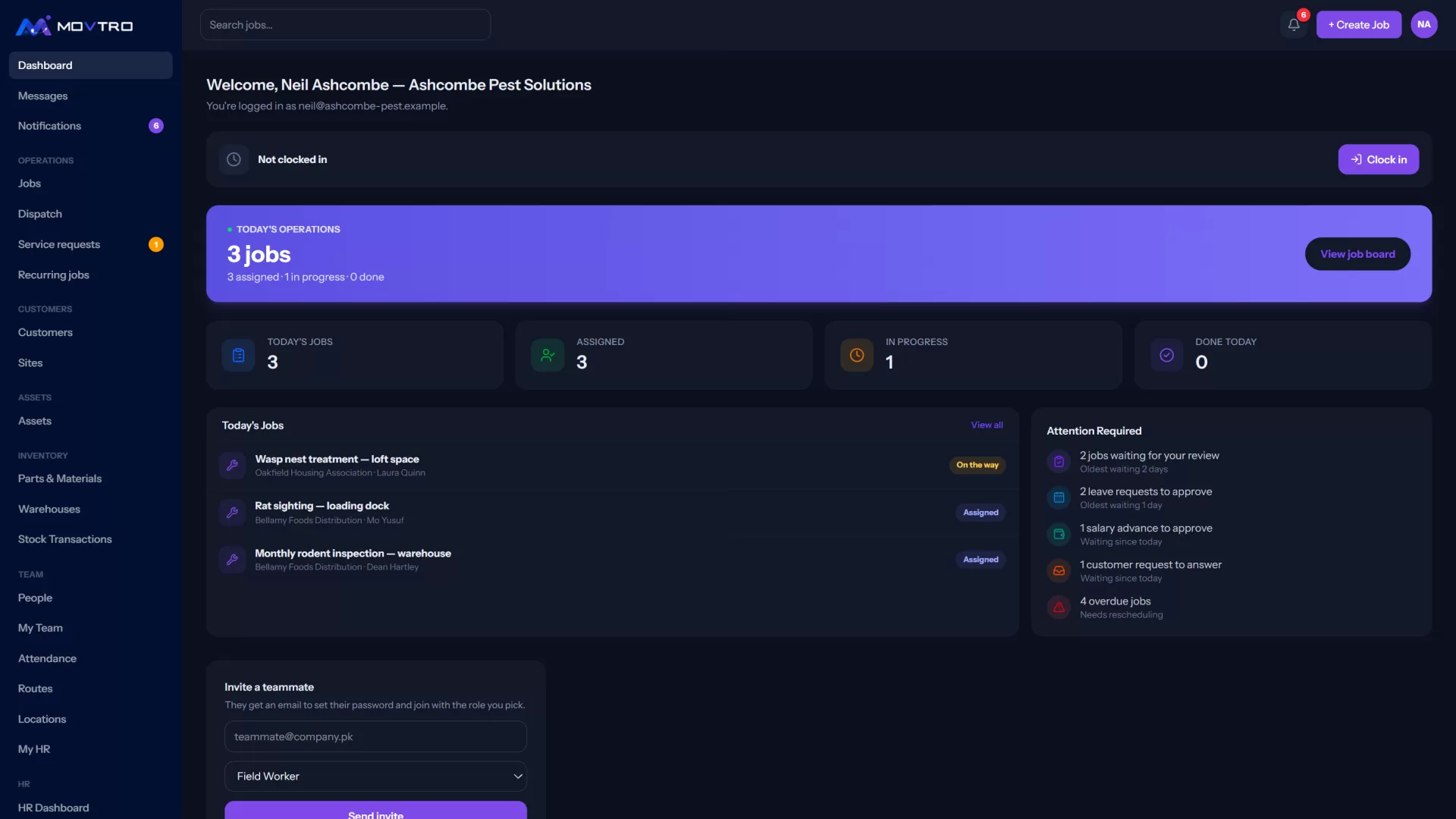
In Movtro, recurring treatments run as recurring jobs. You set the customer, site, checklist, technician and frequency once, and each visit is created in advance and appears on the technician's phone. Missed visits are flagged as overdue. Call-outs are ordinary jobs, and customers can also request them through the portal.
On site, technicians work through the checklist, note activity and recommendations, take photos and capture the customer's signature, with or without signal. Products are recorded as materials used on the job and taken from the stock at the van or store they came from, so you can see usage by job and by site. Access notes on a site show on every job there.
Movtro does not produce regulatory chemical-use returns for you, but the usage recorded on each job is there to report from.
See preventive maintenance software, or start free.
Related: Recurring Pest Control Service Management · Pest Control Service Reports and Chemical Usage Records