HVAC Field Service Management: The Whole Job, Call to Sign-Off
How HVAC service teams take a call from the first ring to the signed service report, covering equipment history, peak-season dispatch, parts, checklists and maintenance agreements.
HVAC service follows a yearly pattern that most trades don't have. For most of the year the work is planned: installations, preventive servicing, contract visits. Then the first heatwave comes and every unit that was going to fail fails in the same fortnight. A system that works in April has to survive June.
This guide follows an HVAC service call from start to finish and looks at what an HVAC business needs from its field service management at each step.
The job, step by step
1. The call
"The AC isn't cooling." The first task is to turn that into something a technician can act on:
- Which unit? A house may have four splits, an office a VRF system with twenty indoor units, a factory package units and a chiller.
- What exactly is happening? Not cooling, not turning on, leaking water, noisy, tripping the breaker, an error code on the display.
- Is it under warranty, or covered by a maintenance agreement?
- How urgent is it? A server room, a hospital ward or a restaurant kitchen in July is in a different category from a spare bedroom.
If the unit is already on record, most of this is answered before the customer finishes describing it: model, capacity, refrigerant type, install date, last service and previous faults.
2. Dispatch
In peak season, dispatch decides whether the day works. The right technician has the skills for the job (a VRF fault is a different job from a split-unit service), the certification to handle refrigerant, the parts likely to be needed, and a sensible route from their current job. See technician dispatch best practices.
3. On site: diagnosis
The technician checks the basics first: power supply, thermostat settings, filters and airflow at the outdoor unit. Then come the measurements an HVAC diagnosis rests on: suction and discharge pressures, superheat and subcooling, amp draw on the compressor and fan motors, and the temperature difference across the coil.
Recording those readings on the job turns a one-off visit into history. The next technician can see that the pressure has been drifting down over three visits, which means a leak that a gas top-up won't fix.
4. Parts and approval
The common failures have common parts: capacitors, contactors, fan motors, PCBs, sensors and refrigerant. When the fix goes beyond what the visit covers, such as a compressor or a leak repair, the customer approves the cost before the work goes ahead, and that approval should be on the record.
5. The service itself
A standard service checklist keeps quality even across the team:
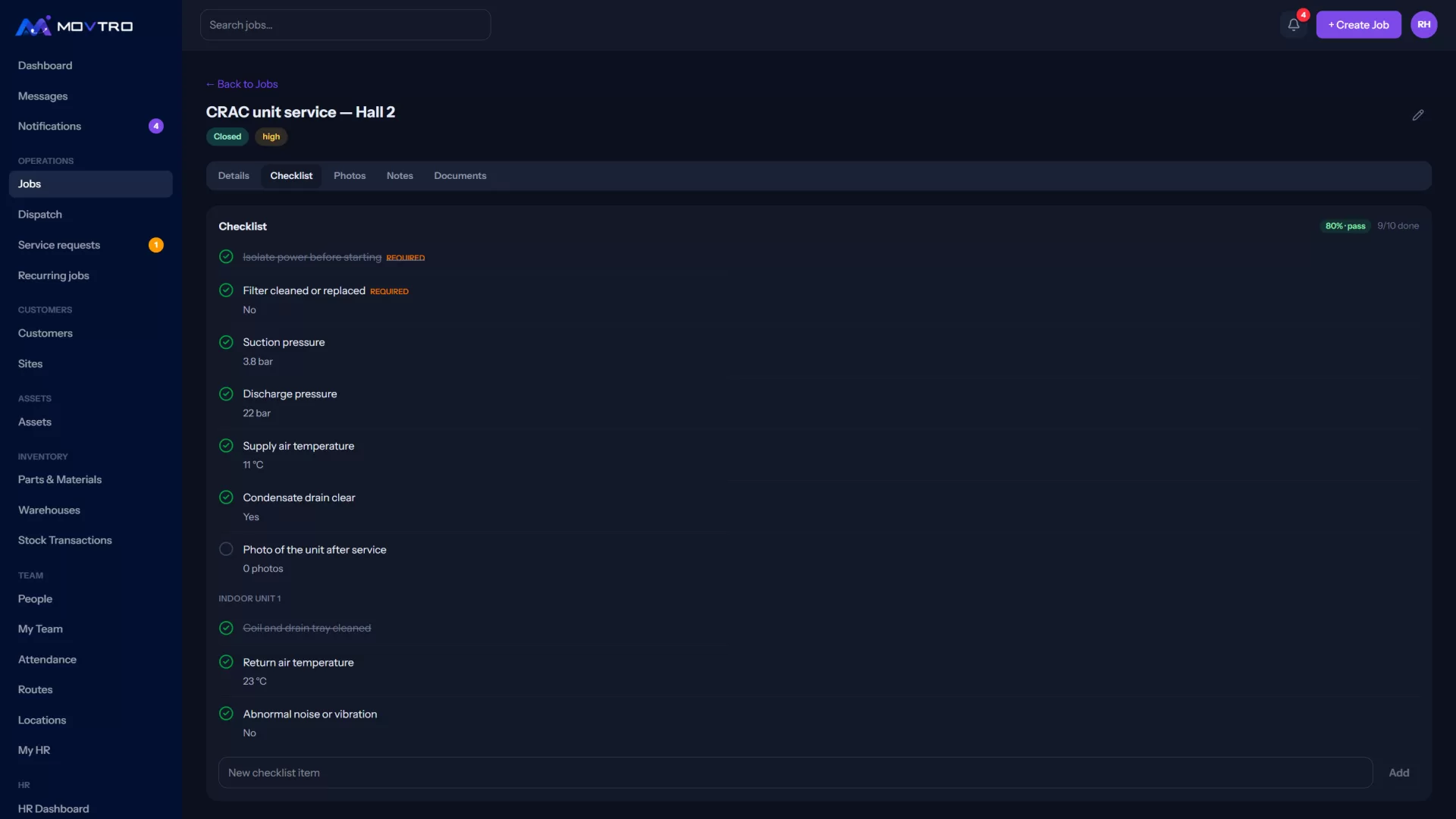
- Clean or replace filters
- Clean the evaporator and condenser coils
- Clear the condensate drain line and check the tray
- Check refrigerant pressures and note the readings
- Check electrical connections and measure amp draw
- Check the thermostat and controls
- Test run and note the supply and return air temperatures
- Photograph the unit before and after
6. Sign-off and report
The customer signs and gets a report of what was found, what was done and what is recommended. The unit's history is updated for next time.
Maintenance agreements
Preventive maintenance agreements are the most valuable work in HVAC. They bring predictable revenue and fewer emergency calls, and the customers stay. The usual pattern is a quarterly or twice-yearly service, often timed for before summer. The hard part is making sure every visit actually happens on time without someone carrying a calendar of contracts in their head. Each visit should create itself ahead of time, with the right checklist for the right units.
The peak season
When demand spikes:
- Triage by impact rather than by who rings loudest.
- Keep the most common parts in every van. In peak season a return trip for a capacitor costs you a customer and half a day.
- Tell customers where they are in the queue so they stop ringing.
- Protect planned maintenance where you can. The units you serviced in spring are the ones not failing now.
Numbers worth watching
- First-time fix rate, especially in peak season. See first-time fix rate.
- Repeat visits to the same unit within 30 days.
- Agreement visits completed on time.
- Parts used per job type, for setting van stock.
See field service KPIs for how to measure them.
In Movtro
In Movtro, each unit is an asset at the customer's site, with its model, serial number, warranty and full service history. Customers can raise a request through the portal, and dispatch turns it into a job. Dispatch assigns from one board and can get a suggestion of who to send based on skills, workload, availability and travel time. Technicians' certifications are recorded with expiry dates, and Movtro reminds you before they lapse.
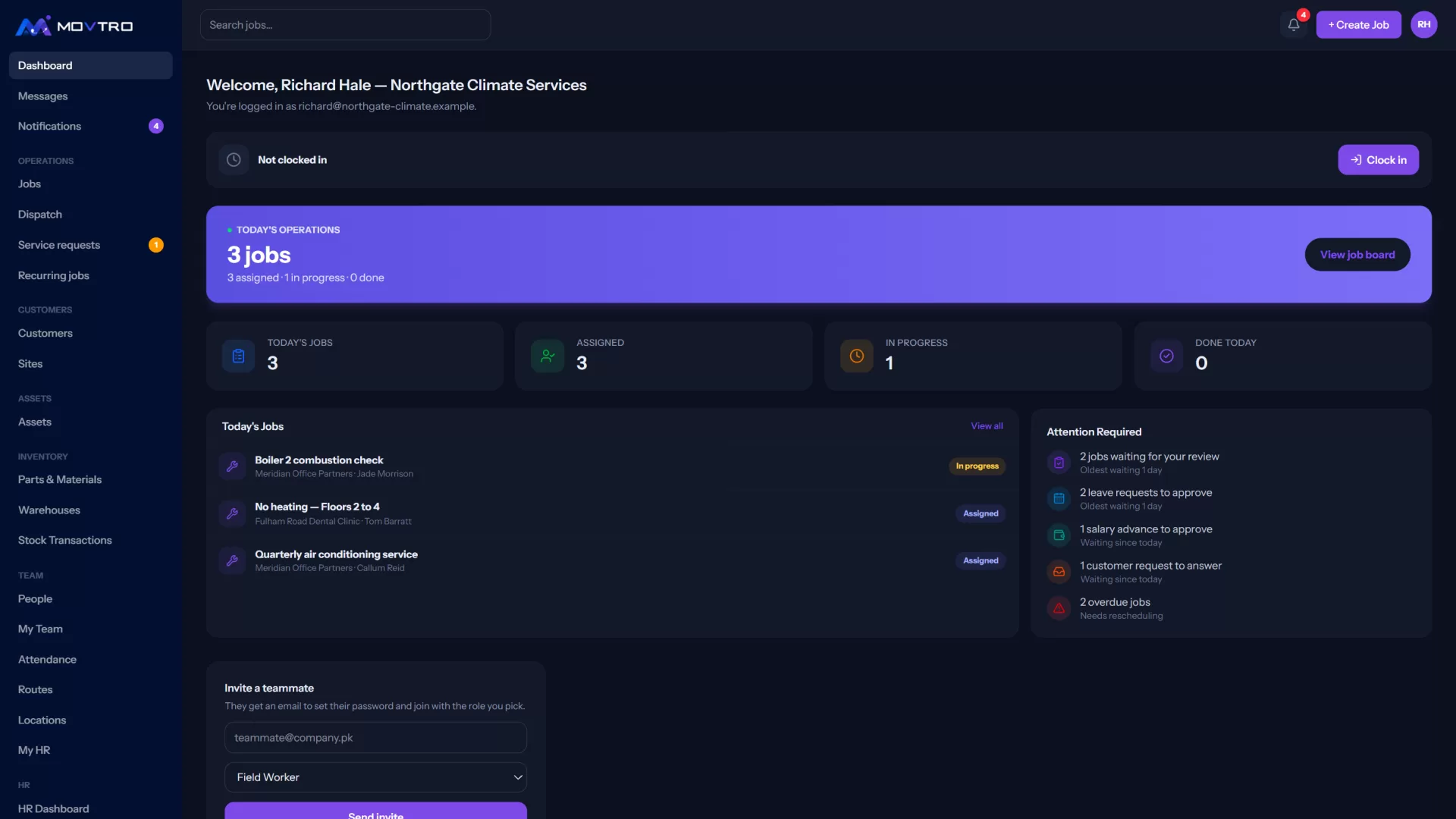
On site, the technician works through the checklist on their phone, where pressures, currents and temperatures are number questions with a unit and an expected range. They add photos, log parts from stock and capture the customer's signature, with or without signal. Customers can approve the finished work in the portal, or send it back if something is not right. Maintenance agreements run as recurring jobs. You set the units, the checklist and the schedule once, with a contract end date, and each visit is created ahead of time, either as one job per unit or one job for the whole visit.
Movtro does not handle contract pricing or invoicing. Readings are their own checklist questions with a unit and an expected range; a reading outside the range is flagged and reports a problem on the job by itself. A unit's record can also carry your own custom fields.
See work order management, or start free.
Related: HVAC Maintenance Agreements: Running Them So Every Visit Happens · Field Service Checklists: Getting the Work Done Right Every Time · HVAC Service Checklist: What Every Maintenance Visit Should Cover · HVAC Dispatch Software: Getting Through Peak Season · HVAC Technician Certifications and Skills: Keeping Track · HVAC Parts and Van Stock Management